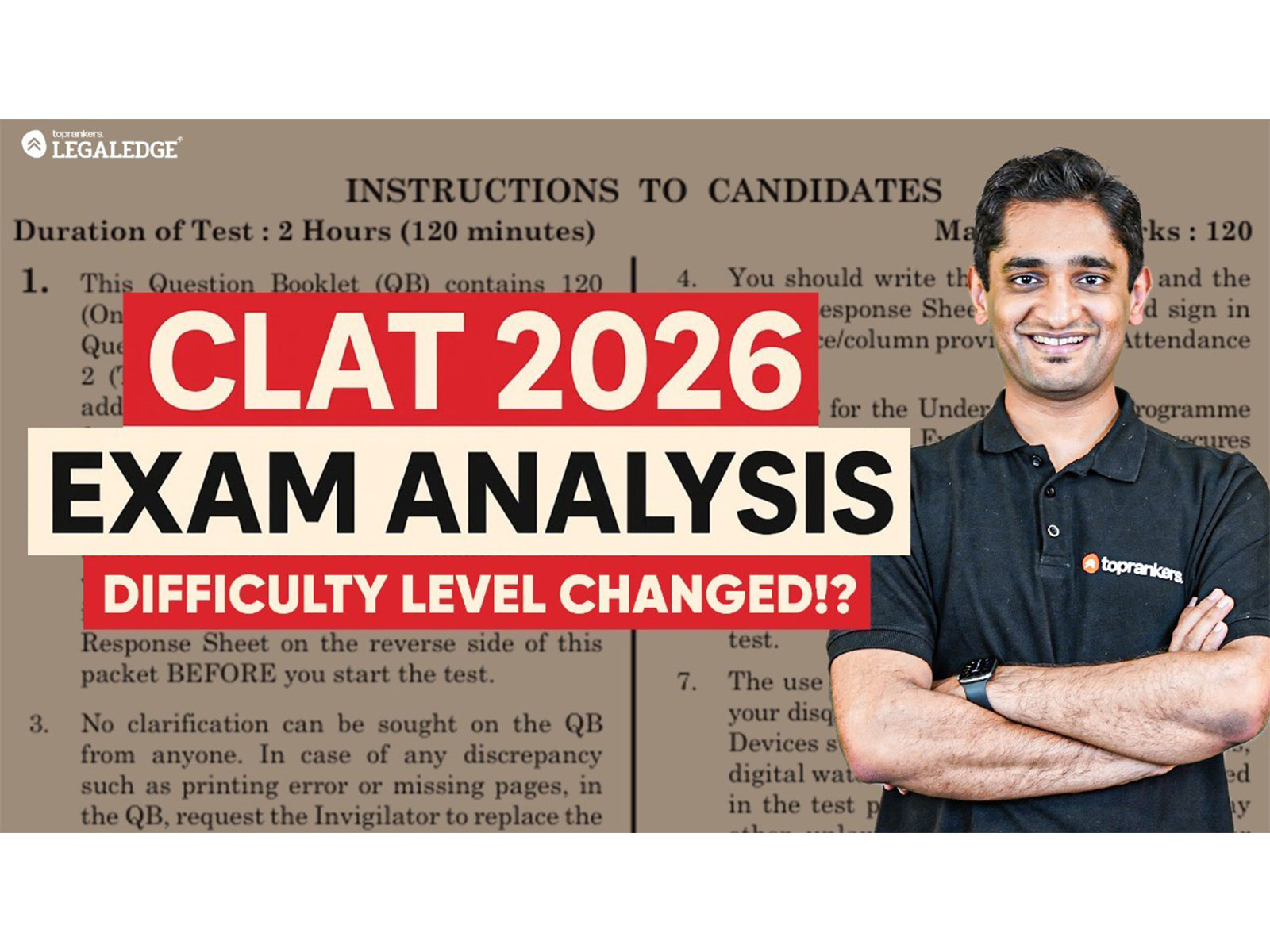
CLAT 2026 Exam Analysis by Harsh Gagrani, Co-Founder, LegalEdge by Toprankers
Dec 08, 2025
VMPL
New Delhi [India], December 8: After the roller-coaster that was CLAT 2025, it was natural for aspirants to walk into CLAT 2026 with a mix of hope, anxiety, and uncertainty. CLAT 2025 was far from smooth -- what should have been a routine exam cycle turned into months of litigation, urgent hearings, contradictory court orders, revised results, and widespread errors. It is a year remembered for all the wrong reasons, shaking the confidence of thousands of students.
Amid this anxiety, the Consortium released two sample papers in the final week before CLAT 2026, signaling a possible shift in difficulty.
CLAT 2026 delivered exactly that a moderate-level, balanced exam, noticeably more challenging than the unusually easy CLAT 2025, yet fair and well within the expected pattern.
Overall Difficulty Level: Moderate
CLAT 2026 Section wise difficulty level
- GK: Easy
- Legal Reasoning: Easy to Moderate
- English Language: Easy to Moderate
- Quantitative Techniques: Easy
- Logical Reasoning: Moderate & Tricky
Good Attempts: 105+
Section-Wise Analysis
1. English Language - Easy to Moderate
What Defined This Section
- Shift towards vocabulary-heavy questions compared to previous years.
- Passages were literature-oriented (Sapiens, Animal Farm) instead of news-driven topics.
- Reading complexity was moderate, but passages required careful interpretation.
- Question distribution ensures a balance between inference, tone, meaning, and contextual vocabulary.
2. Logical Reasoning - Moderate & Tricky (Most Challenging Section)
The Game-Changing Twist
Students expected conventional Critical Reasoning. Instead, the section shifted significantly towards Analytical Reasoning, surprising many.
What Appeared
- Blood relations
- Ordering & sequences
- Coding-decoding
- Caselist-style logic
- Deductive reasoning puzzles
- One particularly difficult Tabular Arrangement set, which was:
- Time-consuming
- Prone to misinterpretation
- The single biggest bottleneck in the entire paper
3. Legal Reasoning - Easy to Moderate
What Worked
- Very predictable and student-friendly.
- Covered contemporary themes such as:
- Same-sex marriage
- Governance
- Basic legal principles
- No unusual or complex passages; clarity of principles mattered most.
- Direct, traditional CLAT-style questioning.
One of the most scoring sections this year.
4. General Knowledge / Current Affairs - Easy
Nature of Questions
- Direct, predictable, current-affairs driven.
- Topics included:
- American taxation
- SCO
- Air India
- Pahalgam
- Major national/international events
The highest-scoring section of CLAT 2026.
5. Quantitative Techniques - Easy (Calculative)
What Appeared
- Ratio
- Percentage
- Proportion
- Arithmetic fundamentals
Key Takeaways from CLAT 2026
1. Logical Reasoning defined the exam, especially the difficult Tabular Arrangement set.
2. GK and Legal remained the biggest scoring areas for aspirants.
3. QT was clean, calculation-oriented, and predictable.
4. CLAT 2026 marked a return to a balanced, fair, and structured paper after the turbulent CLAT 2025 cycle.
Conclusion
CLAT 2026 was a balanced, fair, and moderately challenging paper -- a significant improvement in structure and quality after the turbulent CLAT 2025 experience.
We wish all CLAT 2026 aspirants the very best and extend our warmest wishes to everyone appearing for AILET 2026 exam this Sunday. Give it your best -- the journey continues, and your hard work will carry you through.
Harsh Gagrani
Co-founder
LegalEdge-Toprankers
(ADVERTORIAL DISCLAIMER: The above press release has been provided by VMPL. ANI will not be responsible in any way for the content of the same.)