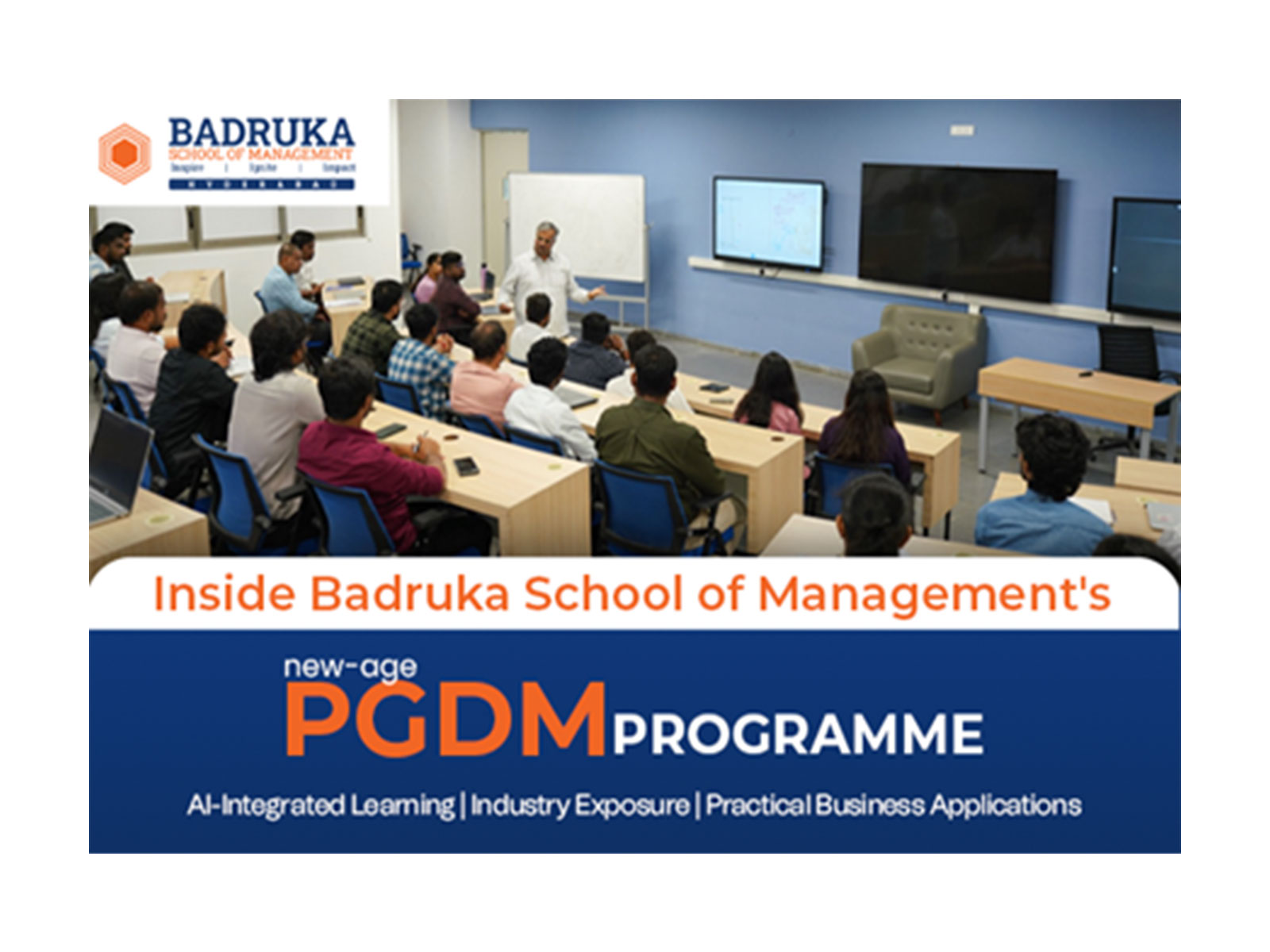
Exploring BSM's PGDM Curriculum: Specialisations, Applied Learning and Industry Exposure
Nov 04, 2026
VMPL
New Delhi [India], November 4: Management education is evolving to meet changing industry requirements and placement opportunities. The curriculum is designed around the latest job demands, helping students develop the business knowledge, analytical abilities and practical skills required to succeed in the workshop.
The two-year, full-time residential Post Graduate Diploma in Management (PGDM) at Badruka School of Management (BSM), Hyderabad, is designed to align with current industry expectations and emerging career opportunities. The AICTE approved programme combines fundamental management courses, specialisation courses, applied projects and industry exposure to help students build relevant skills and apply their learning to real-world business scenarios.
Seven specialisation to shape career interests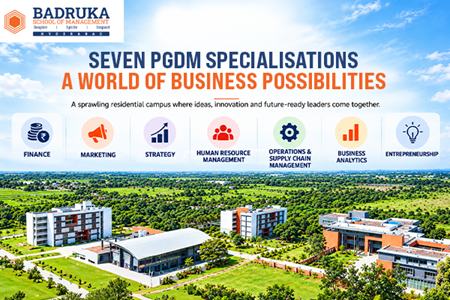
One of the important aspects of BSM's PGDM programme is the various specialisation areas it offers, allowing students to delve into diverse facets of business and focus on areas of interest.
Seven specialisations are available in the PGDM programme, designed to align with industry requirements and career opportunities across key business functions:
- Finance: Prepares students for roles in financial analysis, investment banking, corporate finance and business valuation
- Marketing: Develop skills for careers in brand management, digital marketing, market research, and marketing strategy.
- Strategy: Builds capabilities for roles in the business strategy, management consulting, competitive analysis and strategic decision-making
- Human Resource Management: Prepares students for careers in talent acquisition, HR business partnering, employee relations and organisational development
- Operations and Supply Chain Management: Equips students for roles in operations management, supply chain planning, logistics and process improvement
- Business Analytics: Develops skills relevant to careers in business analytics, data analysis, business intelligence and data-driven decision-making
- Entrepreneurship: Helps students explore opportunities in venture creation, startup management, innovation and business development
The programme information provided by BSM today outlines a two-specialisation programme that is flexible, allowing students to choose electives from selected fields, depending on the programme's requirements. This allows students to build up business skills in a specific discipline with a supporting knowledge of other areas.
AI-powered learning in evolving work environments
Information is being analysed, operations managed and decisions made in businesses in increasingly innovative ways, with the aid of technology. Unlike just using AI as a subject, BSM embeds AI into its management learning process.
It features subjects like business analytics, digital businesses and strategic management, as well as courses in Artificial Intelligence and Machine Learning for Managers. Prompts, design thinking, problem solving and decision making are all incorporated in the core curriculum of management with essential skills and perspectives courses.
The “multi-disciplinary approach” is designed to enable students to grasp the connection between technology and business decisions. Students can explore the potential of AI and digital tools in various organisational functions by studying both the tools and management concepts together.
Extra-curricular learning that is applied
The PGDM offered by BSM has a pracademic approach, bridging the gap between academics and business. It is based on learning techniques like case study, simulation, real life corporate and social projects and industry expert engagement, with practical exercises.
Students will be exposed to issues in the business environment and will learn to work collaboratively, communicate and analyze to solve these issues. Students do not only learn management subjects from a theoretical point of view, they are provided with opportunities to consider how decisions are taken in real organisations.
The programme also adopts a block teaching approach, where subjects are taught in learning blocks. BSM states this is to enable students to think in greater depth about individual subjects and link academic work with product outputs.
Practical experience and business visits
Another important component of the PGDM curriculum at Badruka School of Management (BSM) is industry exposure through internships, corporate interactions, guest sessions and applied projects. The programme includes a compulsory three-month summer internship before the commencement of the second year, carrying academic credits towards programme completion.
BSM's published internship ecosystem includes organisations such as IKEA, Tech Mahindra, Dabur, Wakefit, Bajaj Finserv, Decathlon, Lenskart, BharatPe and FlexiLoans. These opportunities expose students to diverse business environments across sectors such as technology, financial services, retail, consumer goods and e-commerce.
The summer internship enables students to apply classroom concepts to real-world business challenges, understand workplace expectations and develop practical problem-solving skills. Through industry interactions, guest sessions, mentorship and project-based learning, students gain insights into business operations, organisational practices and strategic decision-making.
In addition to internships, corporate engagement and live projects help students understand industry expectations and explore potential career pathways. These experiences can strengthen professional skills, encourage analytical thinking and help students connect management theory with business practice. However, specific internship opportunities, project assignments and career prospects may vary depending on organisational requirements and individual student profiles.
Development of a wider management outlook
In addition to being able to do something, communication and leadership skills, along with ethical judgment and problem solving skills are required. BSM's Essential Skills and Perspectives courses cover these areas, including business communication, presentation and storytelling, persuasive writing, business ethics and managing self and others.
In addition to these skills, BSM includes management fundamentals, as well as skills in specialisations, AI-integrated learning and industry exposure, to prepare students for a business environment where they need to work across functions and respond to changing management needs.
It provides a formal way for students to explore the various fields of business, specialise and build their practical experience in a residential setting for those who are looking into business schools for management education. The curriculum spans and integrates academic learning and work-based experiences, providing a variety of opportunities for students to develop the skills needed for their future work.
(ADVERTORIAL DISCLAIMER: The above press release has been provided by VMPL. ANI will not be responsible in any way for the content of the same.)