Surgy Health launches SurgyOne, an agentic AI-first HIS/EHR for mid-market hospitals in India and the GCC
Oct 23, 2026
VMPL
Bengaluru (Karnataka) [India], October 23: Surgy Health, a Bengaluru-based AI-first hospital software company, today launched SurgyOne for mid-market hospital groups in India and the Gulf Cooperation Council (GCC) countries. SurgyOne is an agentic AI-first hospital information system (HIS) and electronic health record (EHR), built around an AI agent that can find information, draft routine work and carry it out once a member of staff approves. It is available now for demonstrations and pilots.
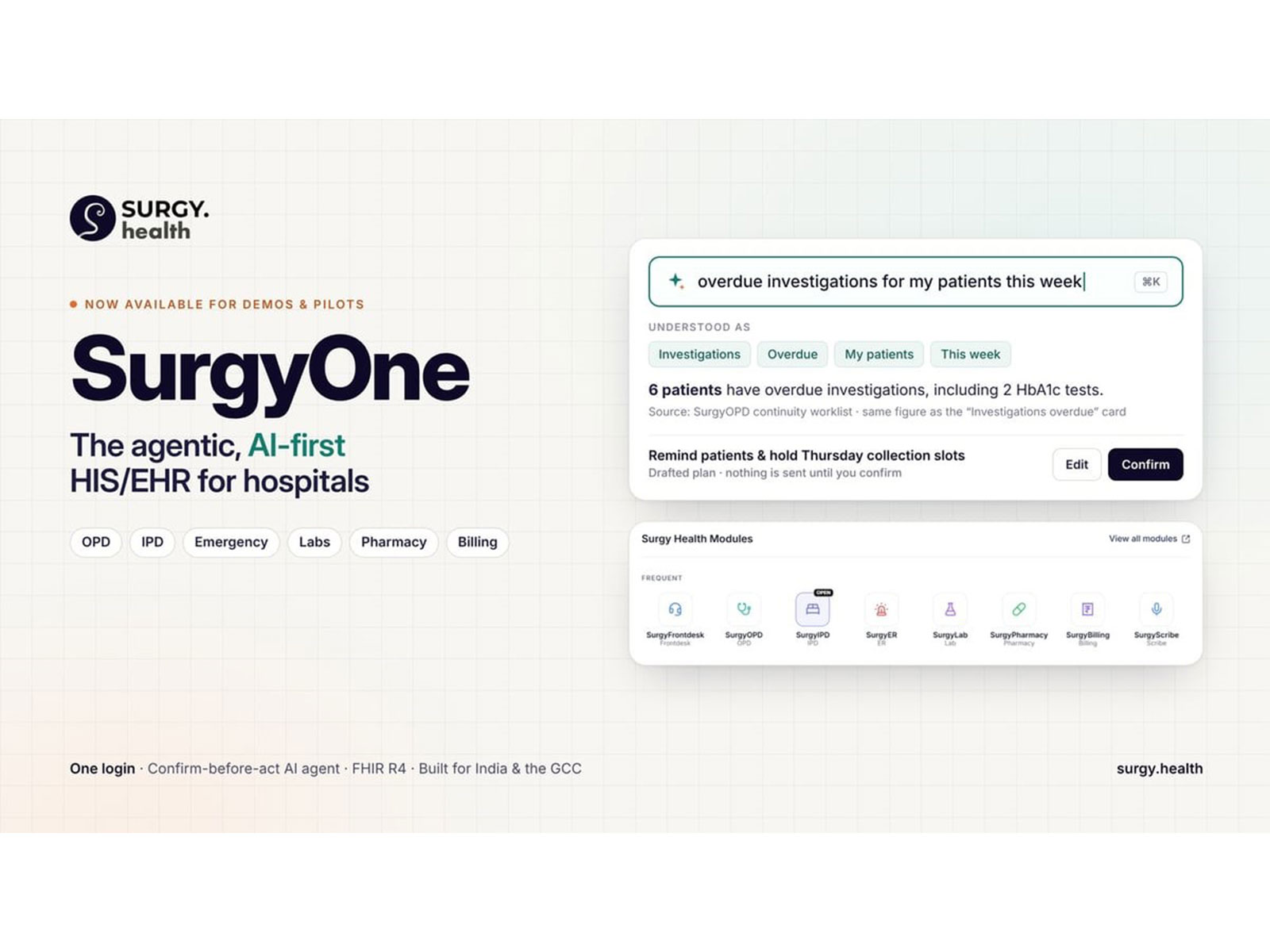
SurgyOne covers six areas of hospital work from day one: outpatient care (SurgyOPD), inpatient care (SurgyIPD), emergency (SurgyER), laboratory and radiology (SurgyLabs), pharmacy (SurgyPharmacy) and billing (SurgyBilling). All six share a single login and a single patient record, so details captured at registration, in a consultation or at the bedside do not have to be keyed in again further down the line. Surgy Health’s first hospital deployment is under contract and scheduled to go live between December 2026 and January 2027.
The launch comes as Indian hospitals spend more on technology while struggling with the systems they already own. In the CII-EY HealthTech Survey 2025, providers said they expect IT innovation budgets to rise 20–25% over the next two to three years, and named legacy systems and integration problems among their biggest obstacles.
“Most hospitals we speak to run core systems that are close to twenty years old, and every AI tool they buy sits outside them,” said Mohammed Jamil Nasir, founder of Surgy Health, who leads product and technology. “We built SurgyOne the other way round. The agent already knows the patient, the queue and the bill. It prepares the follow-up work, and a person approves every action before anything happens.”
What makes SurgyOne an agentic HIS?
An agentic hospital information system is one in which the AI can plan and carry out multi-step tasks, not only answer questions or summarise records. In most hospital systems in use today, AI tools run as separate applications beside the system of record. In SurgyOne, the agent works inside every module and sees only what the signed-in user is permitted to see.
Staff reach the agent from the search bar on every screen. A front-desk coordinator can type part of a patient’s name; a consultant can ask, in ordinary language, for “overdue investigations for my patients this week”. The agent shows how it has read the request, answers from the hospital’s live records and cites the source of each figure.
When a task follows, such as reminding patients, holding sample-collection slots or alerting a ward, the agent writes out a plan and waits. Nothing is sent, booked or posted until the user approves it, and every step is logged under that user’s name. Clinical decisions stay with clinicians: the agent cannot order tests, sign results, triage patients or discharge them.
Each module also carries its own predictive tools. SurgyIPD tracks early-warning scores continuously and flags patients likely to be ready for discharge 24 to 48 hours ahead. SurgyER suggests triage acuity and raises sepsis, stroke and heart-attack protocols. SurgyBilling checks claims for denial risk before submission and builds every charge from a clinical event, so nothing is entered by hand.
Does SurgyOne support ABDM and NPHIES?
SurgyOne exchanges data using the HL7 FHIR R4 standard. In India it is built to work with the Ayushman Bharat Digital Mission (ABDM), which had issued more than 97 crore (970 million) ABHA health IDs and linked over 119 crore (1.19 billion) health records by September 2026, according to the Press Information Bureau. In Saudi Arabia it is designed for NPHIES, the national platform for insurance eligibility, pre-authorisation and claims. Settings at each hospital location apply the relevant local rules, from consent under India’s Digital Personal Data Protection (DPDP) Act to GST and ZATCA e-invoicing and Arabic-language documents.
Where does SurgyOne’s AI process patient data?
The agent is designed to run on MedGemma, Google’s open medical AI models, which Surgy Health hosts and manages on its own infrastructure, so patient records are not passed to a third-party AI service. Before any action is switched on, each module’s agent runs in shadow mode, with actions disabled, until it passes an evaluation that includes cases written by clinicians.
Which hospitals use Surgy Health’s AI products?
SurgyOne extends a suite of AI products that Surgy Health already runs for 10 hospital groups, with more than 4,000 healthcare users across 500-plus centres in India, Kuwait and Bahrain.
- SurgyScribe, an ambient clinical documentation tool, works inside a hospital’s existing EHR. At Apollo Clinic in Kuwait it reduced the time doctors spend on notes from 10–15 minutes to 1–1.5 minutes per consultation, in English and Arabic.
- SurgyFrontdesk, an AI voice agent for patient calls, appointment booking and follow-ups, has cut call-centre workload by up to 80%.
- SurgyCRM manages patient journeys from first enquiry to follow-up for hospital groups including Mediversal Hospitals in Bihar.
- SurgyLearn turns hospital SOPs into training courses up to 90% faster. DCDC Kidney Care has used it to train and certify more than 1,800 employees across its dialysis network.
Two further products, SurgySettle for insurance claims and TPA reconciliation and SurgyInsight for conversational hospital analytics, are in pilot.
“Hospital groups already rely on us for documentation, patient calls and staff training,” said Pankaj Singh Brijwal, co-founder of Surgy Health, who leads growth. “SurgyOne brings their core operations onto the same system. From today we are opening demonstrations and pilots to hospital groups in India and the GCC.”
When is SurgyOne available?
SurgyOne is available for demonstrations and pilots from today. Hospital groups can request a demo at surgy.health or by writing to info@surgyy.com.
SurgyOne at a glance
- What it is: an agentic AI-first hospital information system (HIS) and electronic health record (EHR) from Surgy Health, Bengaluru.
- Modules at launch: SurgyOPD, SurgyIPD, SurgyER, SurgyLabs (including radiology reading), SurgyPharmacy and SurgyBilling, on one login and one patient record.
- How the AI agent acts: it answers from live hospital records with sources, drafts tasks and runs them only after a staff member approves; clinical decisions remain with clinicians.
- Standards and compliance: HL7 FHIR R4; built for ABDM in India and NPHIES in Saudi Arabia, with DPDP Act consent controls.
- Where the AI runs: MedGemma models hosted and managed by Surgy Health, not a third-party AI service.
- Who it is for: mid-market, multi-specialty hospital groups, typically two or more hospitals with 500–1,500 beds, in India and the GCC.
- Availability: demonstrations and pilots now; first hospital go-live scheduled for December 2026 to January 2027.
About Surgy Health
Surgy Health (Surgy Innovation Labs Private Limited) is an AI-first hospital software company based in Bengaluru, India. It began in 2020 as Surgyy Design Labs, a UX and product design studio founded by Mohammed Jamil Nasir that delivered more than 50 projects. In 2024, Pankaj Singh Brijwal, an enterprise sales and go-to-market leader, joined Nasir as co-founder, and the company pivoted to AI software for hospitals. Its products, SurgyOne, SurgyScribe, SurgyFrontdesk, SurgyCRM, SurgyLearn, SurgySettle and SurgyInsight, now serve more than 4,000 healthcare users across 10 hospital groups and 500-plus centres in India, Kuwait and Bahrain. Learn more at https://surgy.health.
Media contact
Mohammed Jamil Nasir, Founder, Surgy Health
Email: nasir@surgyy.com · General enquiries: info@surgyy.com
Phone: +91 70644 65935
91 Springboard, 175 & 176 Bannerghatta Road, Dollar Layout, Bengaluru, Karnataka 560076, India
surgy.health
(ADVERTORIAL DISCLAIMER: The above press release has been provided by VMPL. ANI will not be responsible in any way for the content of the same.)