The fastrr Checkout RTO Prevention Playbook: A Step-by-Step Guide for Indian D2C Brands
Sep 23, 2026
PNN
New Delhi [India], September 23: Return to Origin (RTO) is one of the biggest profitability challenges for Indian D2C brands. Every failed delivery can mean forward and reverse shipping costs, blocked inventory, handling expenses and lost revenue.
But eliminating Cash on Delivery isn't necessarily the answer. COD remains an important payment option for Indian shoppers, particularly for first-time buyers and customers who prefer paying at delivery.
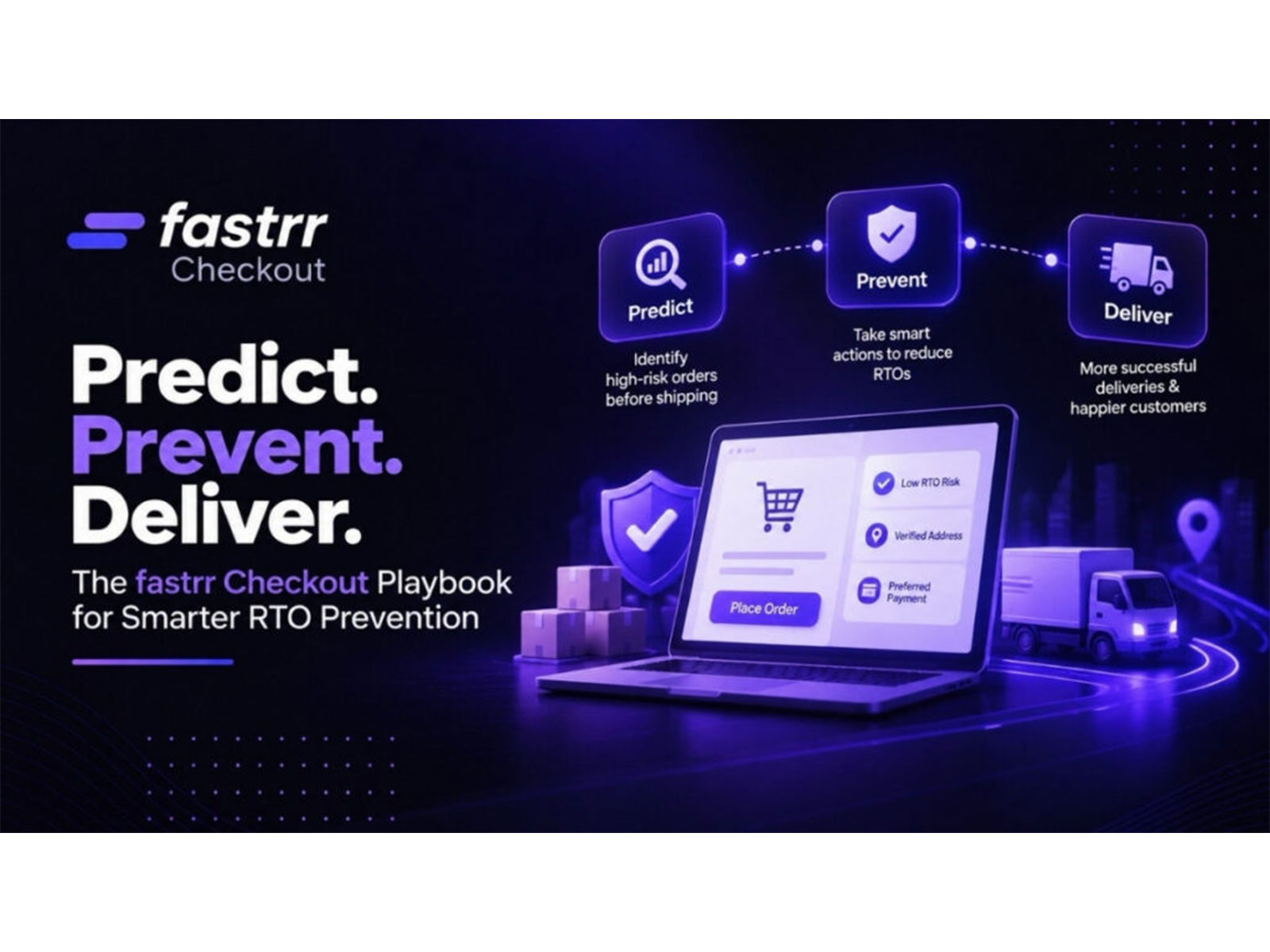
Based on its experience with ecommerce brands, fastrr Checkout has developed this RTO Prevention Playbook to help merchants identify and address delivery risk before an order is shipped. The approach combines AI-powered risk prediction, intelligent COD controls, Partial COD, prepaid conversion, buyer verification and address intelligence.
The principle is simple: RTO prevention should begin at checkout, not after a shipment fails.
Step 1: Identify Where Your RTO Is Coming From
RTO doesn't affect every order equally. Brands should analyse their RTO across:
- COD vs prepaid
- New vs returning customers
- Pincodes and geographies
- Product categories
- Order values
- Customer and delivery history
- Address quality
The objective is to identify which orders are most likely to become RTOs and why, rather than applying the same restriction to every customer.
This is where checkout analytics can provide an important advantage: brands can identify risk patterns while there is still an opportunity to intervene.
Step 2: Predict RTO Risk Before Shipping
Traditional RTO management is reactive. By the time a shipment fails, the cost has already been incurred.
fastrr Checkout’s AI-powered RTO Prediction helps identify potentially risky orders during the checkout journey using signals such as buyer behaviour, delivery history, location and address information.
That allows merchants to differentiate between lower- and higher-risk orders and apply different interventions.
A fastrr-powered D2C brand, used RTO prediction alongside Partial COD and other risk controls. Of 1,525 very-high-risk carts, only 13 proceeded to an order, meaning more than 99% did not proceed under the applicable controls.
The takeaway: don't wait for RTO to happen. Identify the risk while you can still change the outcome.
Step 3: Make COD Risk-Based, Not Unavailable
Blanket COD restrictions can reduce risky orders, but they can also prevent genuine customers from completing purchases.
Instead, brands can make COD conditional based on:
- Pincode
- Order value
- Product
- Customer history
- Predicted RTO risk
fastrr Checkout’s Custom Rules allow merchants to control COD availability at this level of granularity.
This creates a more balanced approach: COD remains available where it makes sense, while higher-risk scenarios receive additional controls.
Step 4: Use Partial COD to Create Buyer Commitment
Some customers may not be fraudulent but may still place impulsive or low-intent COD orders.
Partial COD provides a middle ground. The customer pays a portion of the order online while the remaining balance is collected on delivery.
This creates buyer commitment without removing the convenience of COD.
fastrr Checkout enables merchants to use Partial COD alongside RTO prediction, allowing brands to apply stronger payment requirements specifically where risk is higher.
Step 5: Give COD Customers Another Opportunity to Go Prepaid
The payment decision doesn't necessarily end when a COD order is placed.
Brands can give customers another opportunity to convert their order to prepaid through WhatsApp or SMS, often supported by an incentive.
fastrr Checkout’s COD-to-Prepaid capability enables this post-order intervention, helping merchants reduce COD exposure without forcing every customer to choose prepaid at checkout.
This is particularly useful because the brand gets another opportunity to reduce delivery risk after the customer has already demonstrated purchase intent.
Step 6: Verify High-Risk Orders
Not every customer needs additional verification. But an order combining several risk signals may warrant another layer of validation.
Brands can use:
- OTP verification
- Order confirmation
- Buyer confirmation
- Manual verification for selected orders
The objective is to optimize checkout journey while applying additional scrutiny to exceptions.
Automate the majority. Verify the exceptions.
Step 7: Make Address Quality Part of RTO Prevention
A poor address can turn a genuine order into a failed delivery.
Incomplete addresses, missing landmarks or questionable delivery information can be addressed before fulfilment.
fastrr Checkout’s Address Intelligence helps merchants identify potentially problematic addresses and prompt customers to correct delivery information during checkout.
This approach has also been used alongside broader checkout optimisation by fastrr merchants. In one case, AI-driven address pre-fill achieved accuracy of up to 95%, reducing the effort required from shoppers while improving the quality of checkout information.
Step 8: Reduce Risk Without Sacrificing Conversion
RTO prevention shouldn't become an excuse for adding friction everywhere.
The right approach is risk-based intervention: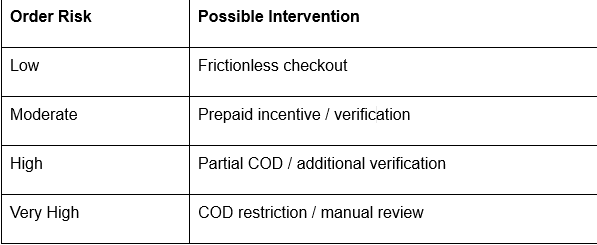
This is where fastrr's approach goes beyond simply identifying risky orders. It connects risk identification with actions inside the checkout journey.
That balance matters. One fastrr merchant increased checkout conversion from 27.86% to 46.24% while also increasing prepaid adoption from 27.37% to around 70–75% during later periods. The merchant's fastrr setup included automated COD risk management.
Step 9: Measure RTO Alongside Conversion
RTO shouldn't be measured in isolation.
Brands should track:
- Overall and COD RTO
- COD vs prepaid mix
- Checkout conversion
- High-risk order share
- COD-to-prepaid conversion
- Partial COD adoption
- Address correction and verification rates
The goal is to improve delivery success without unnecessarily sacrificing conversion.
fastrr checkout and RTO analytics help merchants understand how these interventions affect both order quality and customer behaviour.
Build a Continuous RTO Prevention Loop
RTO prevention isn't a one-time configuration.
A sustainable framework is:
Analyse → Predict → Intervene → Verify → Measure → Optimise
fastrr Checkout brings these interventions together within the checkout journey—from AI-powered RTO prediction and intelligent COD controls to Partial COD, prepaid conversion, address intelligence and verification.
That makes checkout an active RTO prevention layer, rather than simply the final step before fulfilment.
What the Results Look Like in Practice
fastrr Checkout merchant experiences demonstrate that RTO prevention doesn't have to come at the expense of growth.
In one D2C case, risk controls filtered more than 99% of very-high-risk carts from proceeding to an order.
In another, a D2C wellness brand using fastrr Checkout increased prepaid share from 20% to 43.16%, while its checkout conversion rose from 6.41% to 23.18%. fastrr Checkout’s Address Intelligence and COD risk controls formed part of the intervention.
Another fastrr Checkout merchant scaled monthly orders from 1,631 to 5,706, or 3.5X, while maintaining RTO controls and using Partial COD for higher-risk customers.
These cases illustrate the central idea behind the playbook: RTO prevention and ecommerce growth don't have to work against each other.
The RTO Prevention Checklist
D2C brands should ask:
- Do we know which customers and pincodes drive RTO?
- Can we identify risky orders before dispatch?
- Can we selectively control COD?
- Can we create buyer commitment through Partial COD?
- Can we convert COD orders to prepaid?
- Can we verify high-risk customers?
- Can we identify problematic addresses?
- Are we measuring RTO alongside conversion?
If several answers are no, the brand may be managing RTO after it happens rather than preventing it before it happens.
The Goal Isn't Zero COD. It's Fewer Risky Orders.
The future of RTO prevention isn't about removing COD or adding friction to every customer journey.
It's about knowing which orders need intervention and which don't.
fastrr Checkout brings these interventions into a single checkout experience helping brands predict RTO risk, control COD intelligently, create buyer commitment, encourage prepaid payments, improve address quality and verify potentially risky orders.
For D2C brands looking to build a more proactive RTO strategy, the checkout can be the first line of defence.
The goal isn't to say no to more orders. It's to make more of the right orders reach the customer's doorstep.
(ADVERTORIAL DISCLAIMER: The above press release has been provided by PNN. ANI will not be responsible in any way for the content of the same.)